There are two types of Rottweiler: American and German. But despite the two variations (which are often classified as the same dog), the Rottweiller presents characteristics with the same physical and behavioral pattern. It is a large dog breed, renowned for its ability to be a service and guard dog. What many don’t know is that at home with the family, the Rottweiler is completely different: very attached to those around him, affectionate, loving and playful.
Having a Rottweiler dog at home is synonymous with protection and dedication. We talk about background, personality, training, education and more.
Discover the origin of the Rottweiler breed
The German Rottweiler is the officially recognized version of the breed. As the name suggests, they are dogs originating from Germany that appeared many years ago, and their ancestors date back to the time of the Roman Empire, where they were bred for guarding and herding. During a process of soldier migration within the Roman Empire, these dogs arrived in the Rottweil region of the southern Germanic lands, where they were crossbred with local dogs. The result of this “meeting” was the Rottweiler we know today.
At the time of its appearance, the Rottweiler was used to pull meat carts for butchers. Over time, the breed developed other functions and was also used by military forces during major wars. Although it has been around for a long time, the Rottweiler dog breed only gained recognition in 1966.
What are the types of Rottweilers?
We can find the large and imposing Rottweiler in its original and pure version, the German Rottweiler, or in an even larger version, the American Rottweiler. Their origin is the same, but the big difference is that in the United States priority is given to crosses between the larger breeds. This gives the dog an even larger and more robust appearance, but all other aspects such as anatomy and behavior remain the same.
Rottweiler: notable characteristics in addition to size
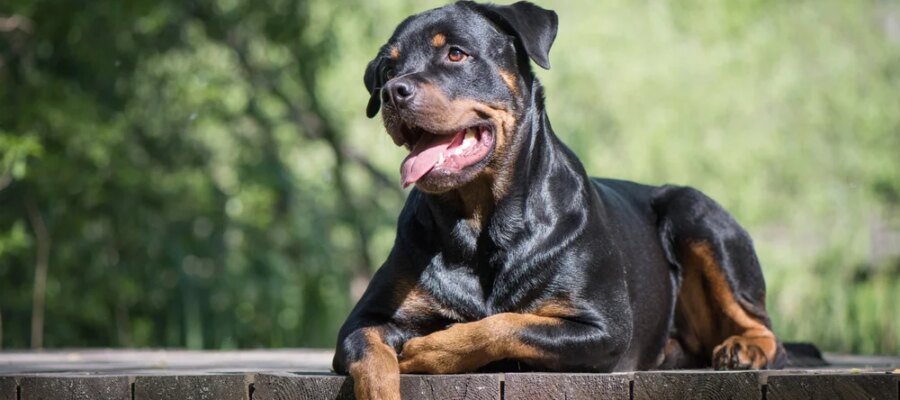
The word that best defines the Rottweiler breed: BIG! These dogs are muscular, sturdy and have an intimidating posture. They have a wider skull than most dogs and for this reason, depending on the size of the head, the breed is sometimes nicknamed the “bear-headed” or “bull-headed” Rottweiler.
The female Rottweiler can reach a height of between 56 and 63 cm and the male can reach heights of between 61 and 68 cm. The ideal weight should be 50 kg, but the minimum acceptable is 35 kg and the maximum is 60 kg. There is no giant Rottweiler, but the largest version of the breed, which would be the American one, can reach 69 cm and weigh up to 80 kg.
In addition to being strong and durable, another aspect that draws attention to the Rottweiler breed is its coat. The dog has a thick, medium-length coat with a rough texture and locks that adhere perfectly to the body. The dog’s colors are not varied: black is the only accepted standard, with well-defined brown markings on the face, muzzle, neck, chest and paws.
Rottweiler: The dog’s strong personality must be shaped from an early age
One of the greatest curiosities of the Rottweiler is the combination of great companion dog and protector of the owners. It is part of the breed’s protective instinct and is also a great sign of loyalty to the family. For a pleasant and safe coexistence with visitors and strangers, it is necessary to balance the animal’s temperament with early socialization.
For those who are already present in the Rottweiler’s daily life, the relationship is fundamental. This dog, contrary to what many people think, is super affectionate, dedicated and fond of people. They can also suffer from what we call separation anxiety if they are not trained to be alone and their owners spend a lot of time apart.
Furthermore, the dog of this breed needs a routine with different stimuli so as not to get bored. Because he is a large and very energetic dog, walks and time spent in nature are very important for energy expenditure. Exercise, combined with a quality diet, is a great way to make your Rottweiler muscular and strong, ready to defend its territory.
It is worth remembering that the Rottweiler needs to live in a place where it has space to move and play. In other words, it is not the best breed for the apartment, as it can become stressed and bored in isolation. On the other hand, it is one of the best breeds for those who live at home.
Given that he is a physically robust and muscular animal and may have difficulty measuring his strength in contact with other people and animals (even during play), the ideal would be to start socialization as soon as he has received all the mandatory vaccinations.
In this way, the Rottweiler puppy will grow up learning to live with other people (and animals) and will be able to distinguish, more easily, when he needs to act as a protector and when he can relax. Be careful with small children and babies, as it can be a little rough at first. The dog’s territorial instinct and dominant behavior is also something that will be alleviated with proper socialization and training.
Knowing how to train your Rottweiler is usually not complicated. An important point to observe in all breeds, but especially in strong ones, is the type of training. It is important that everything happens with positive stimuli, so that the animal does not develop an impulsive and violent temperament during training.
So use and “abuse” treats, toys and affection during your dog’s training, and count on the help of a professional to make sure everything goes smoothly. This way you will create a docile and affectionate yet strong and dominant dog.
The Rottweiler is one of the most intelligent dogs
This breed is among the top 10 most intelligent dogs and has no difficulty understanding commands and showing discipline. Furthermore, he is obedient and loves to please his masters, that is, he will be happy to respond to commands received precisely to please you.
Although it was originally used as a butcher’s pack dog, the Rottweiler has acquired other roles over time. For example, it is one of the most used working dog breeds. In 1910 he was officially recognized as a police dog, but he had to have training aimed at this activity. It is ideal for personal protection or home protection.
5 curiosities about the Rottweiler breed
1) It is one of the dog breeds with the strongest bite, reaching 328 PSI.
2) Will Smith is one of the stars they admire most. The actor has four dogs named Indo, Gracia, Zhaki and Tyson.
3) The names of the most popular dogs of this breed: Zeus, Apollo and Brutus.
4) Some photos of adult Rottweilers show the dog with its tail docked. This practice, called caudectomy, is banned in some countries and classified as abuse.
5) Despite being considered one of the bravest dogs, the Rottweiler is particularly docile with the family and gets along well with children.
Rottweiler puppy: how to care for him and what to expect?
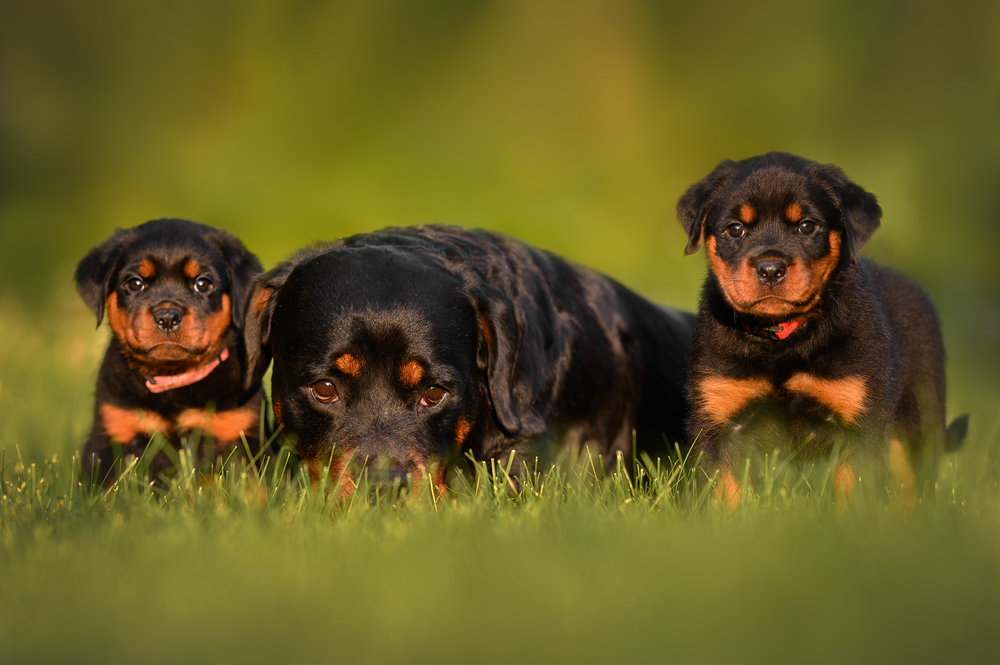
The photos of Rottweiler puppies do not disprove: these dogs, when they are still “small”, make you fall in love immediately! Unlike adults, puppies are not intimidating or clingy. But we must not forget that the strength and resistance of the breed begin to manifest themselves already from the puppy. The Rottweiler develops rapidly and can become quite large in the first few months, demonstrating the same strength as an adult dog. Therefore, it is important to direct all your energy and physical strength towards toys and other activities.
Another important point is food for the animal. The food for Rottweiler puppies must correspond to the age group of the animal and the owner must follow the veterinarian’s instructions regarding the ideal quantity, since these are dogs with a tendency to be overweight. Additionally, the health of dogs of this breed must be carefully monitored, with up-to-date vaccinations. Training and socialization must also begin at this stage.
Basic Rottweiler dog care
- The bathroom: the frequency of bathing for these dogs should be once a month with specific products for dogs. Don’t forget to dry the fur very well after the bath.
- Brushing: Because she sheds a significant amount of hair, brushing your Rottweiler puppy should be frequent, every other day or daily if possible.
- nail: This breed tends to grow quickly, so the owner must be aware of the need to prune them regularly.
- The teeth: It is important to brush your teeth at least two or three times a week. This helps prevent problems such as tartar and bad breath.
- ears: They should be checked weekly to make sure they are in working order.
What do you need to know about Rottweiler dog health?
Unlike other dogs, the Rottweiler is unlikely to have any breed-specific diseases. However, being a large dog, hip dysplasia can become a problem as the Rottweiler approaches old age. Care must be taken to dry it well after rain or playing in water to avoid the development of allergies and dermatitis.
Furthermore, if your vaccination record is up to date, most health problems can be avoided. It is important to maintain the habit of going to the vet for routine checks even if there don’t seem to be any problems. The most suitable food for the Rottweiler is the premium or super premium one which contains all the nutrients the breed needs, keeping it healthy and at its ideal weight.
latest posts published
Are heatwaves and heatwaves coming? Here’s how to protect your dog
8 activities your dog will love
Your dog can feel happy! Here’s how:
Dog too rebellious? Here are some causes of this behavior
Basset Hound – The nobleman with long ears and a sweet heart
9 dog breeds suitable for mountain trips

Are you going to work or on holiday? Here’s everything you need to do to leave your dog safely at home

How your pet can help you adopt a healthy lifestyle
An iconic breed, much more than a lap dog