European roots and fascinating theories about the breed’s ancestors
Although the Poodle was very popular in France where it got its name national cain under the name of poodlethe breed is supposed to originate from Germany, the name “poodle” comes from the German word “pudeln” which means “to throw into water”.
The name is due to the fact that the breed was used to recover various hunted objects from the water.
Some historians believe that the breed was the result of crossbreeding several European water dogs, including those from Spain, Portugal, France, Germany, Hungary and Russia. Other historians believe that one of the dog’s ancestors is the North African barbet, imported to the Iberian Peninsula.
There is also the theory that quadrupeds are the descendants of Asian sheepdogs, then they were taken from the Germanic tribes of the Goths and Ostrogoths and, finally, they became water dogs. Another theory is that the quadruped derives from dogs brought from the steppes of Asia by the North African Berber conquerors and ultimately arrived with the Moors in Portugal, in the 8th century.
Regardless of lineage, the Poodle is a very ancient breed. Egyptian and Roman artifacts and tombs, dating back to the first centuries BC, are decorated with dog designs resembling the poodle. The drawings and statues depict dogs that almost resemble today’s quadrupeds, carrying nets with aquatic animals, accompanying herds and finding game through swamps.
Poodles are known for winning numerous prizes in dog competitions at international tournaments. Poodles are famous for being excellent swimmers and for retrieving various objects from water, as well as foraging for truffles which are considered delicacies in England, Spain and Germany. For this purpose, mainly small poodles were used because the large ones risked destroying the mushroom while digging it up.
After 1400, breeders began making smaller versions of the poodle: miniatures and toys for the enjoyment of the Parisian bourgeoisie. Miniature and toy poodles were the favorite companion dogs of the wealthy.
Over time it was discovered that quadrupeds are very easy to train, very intelligent, and traveling performers took advantage of this opportunity by training them to perform various tricks using them in this way at the circus.
The American Kennel Club registered the first poodle in the club in 1886, while the English Kennel Club did so in 1874.

Poodle Care: Beauty requires discipline
Standard poodles have an average height of 55 cm and a weight of 20-31 kg for males and 20-27 kg for females.
Dwarf poodles have a height of 28-38 cm and a weight of 6.8-7.7 kg, while toy poodles weigh between 2.5 kg and 6 kg.
The latter are preferable because they are easier to maintain and grow in an apartment
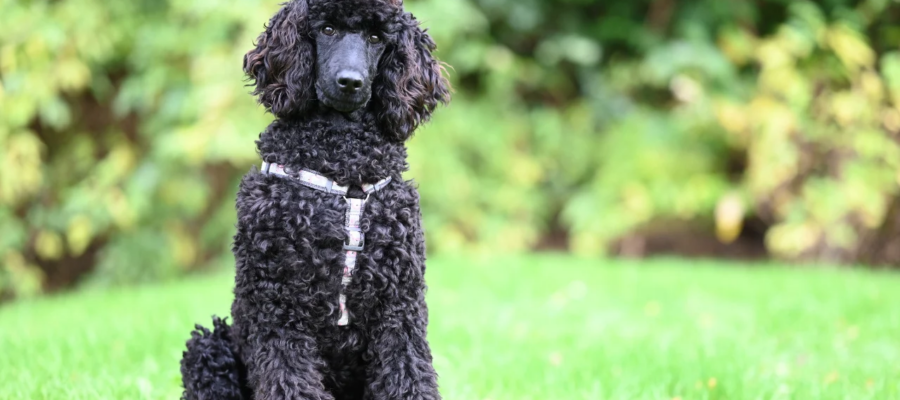
Poodles have wavy, thick, charming fur and come in a wide variety of colors: black, white, gray, silver, brown, brown, cream
The head is proportionate to the body, the skull is well modeled. The eyes are dark, lively, slightly oblique, almond-shaped. The ears hang along the cheeks, wider at the base and rounded at the edges. The solid, lean, slightly curved neck is of medium length. The body is robust, proportionate, the length exceeds the height, the back is short and straight, very harmonious. The front legs are perfectly straight and parallel, elegant, muscular, with strong bones. The hind legs are robust and muscular, and the legs are small, oval and firm. The queue is set quite high, at corridor level.
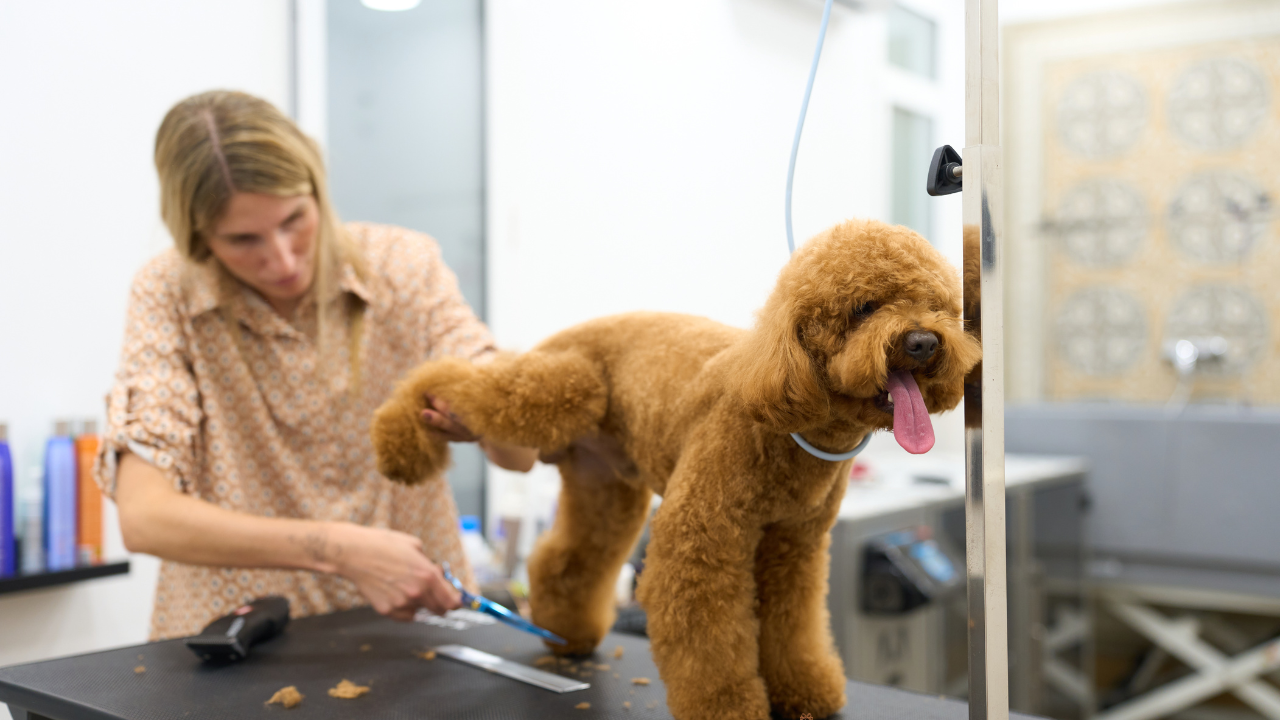
Although they do not shed because they do not have double coats, their care is difficult if you want to keep them up to competition grooming standards. If you are not breeding them for competitions where they require laborious grooming, you can choose to cut them very short, this way their care becomes much easier. If you do not opt for the very short haircut, poodles must be brushed thoroughly and require specialized grooming every 3-6 weeks, which is quite expensive. Poodles tear a lot and the lighter the coat, the more visible the tear stains are. In specialized shops there are special solutions to fade/remove these stains caused by tears.
Breeds with droopy ears are prone to infections because the ear canal is always wet and covered. Furthermore, quadrupeds grow hair in the ear canal. Sometimes these hairs need to be removed. Check your poodle’s ears weekly to see if they are dirty, red or smelly, because a bad odor could indicate an infection.
The temperament of the poodle: a playful genius
The poodle is considered, together with the German shepherd and the border collie, one of the most intelligent dogs. He is creative, intelligent, loyal, loving, very playful and extremely energetic. Since they are very active and energetic dogs, they can get bored very easily if they don’t get enough exercise. Although they are very attached to their family and are friendly to strangers, they are a little reluctant and it takes some time to accept them. The average lifespan of a poodle is 12 years. Dwarf poodles live longer, about 15 years, some even reach 20 years.
Poodle Health: What Every Future Owner Needs to Know
Like every dog breed and the poodle breed, they have some diseases that can be seen more often. To avoid most of them, it is preferable to purchase specimens only from recognized kennels, kennels capable of providing health certificates for the parents and the puppy you are about to adopt (health certificate from the Orthopedic Foundation for Animals for hip dysplasia), shoulder dysplasia, hypothyroidism and von Willebrand’s disease; certified for thrombopathy; by the Canine Ophthalmological Foundation (CERF), which certifies that the eyes are healthy. You can check health certificates on the OFA.org website.
Among the most common diseases in poodles are:
– Addison’s disease – is a disease caused by the fact that the adrenal gland produces an insufficient amount of the hormone adrenaline. Since the symptoms are common to other diseases, the diagnosis is usually made late and when the disease is already in an advanced stage. Dogs affected by Addison’s disease show lack of appetite, vomiting, lethargy.
– Gastric bloating or dilatation/intestinal obstruction. The disease is often found in large, deep-chested dogs that are fed only once a day and make vigorous movements after feeding. Bloating occurs when the stomach becomes inflated with gas or air and turns over. The dog cannot burp or vomit to eliminate excess air in the stomach and normal blood circulation to the heart is hindered. The blood pressure drops sharply and the dog goes into shock. Without immediate medical intervention, the dog could die. If your poodle has a swollen abdomen, salivates excessively and burps without vomiting, urgently consult a doctor
– Cushing’s syndrome – occurs when the body produces too much cortisol or when cortisol is produced by other diseases.
– Epilepsy – is usually hereditary
– Hip dysplasia: It is usually hereditary. Extra pounds or excessive and prolonged physical activity before maturity, an accelerated growth rate, a high-calorie diet or supplements can contribute to hip dysplasia in dogs.
– Hypothyroidism
– Legg-Perthes disease: the blood supply to the head of the femur (the large bone of the hind legs) is reduced and the head of the femur, which connects to the pelvis, begins to degrade. It can be corrected surgically by cutting the diseased part of the femur so that it is no longer attached to the pelvis.
– Patellar luxation – occurs when the knee joint slips forward and outward.
– Progressive retinal atrophy – gradual deterioration of the retina
– Optic nerve hypoplasia – the disease is congenital and consists of underdevelopment of the optic nerve
– Sebaceous adenitis – inflammation of the sebaceous glands of the skin
– Von Willebrand’s disease – genetic disease linked to the speed of blood clotting. There is no cure and the only current treatment is a blood transfusion from a healthy dog.
– Otitis: drooping ears and the large amount of hair inside the ear canal help bacteria to multiply
– For dermatitis
The poodle in the world
Personalities in the cast: Princess Grace Kelly, Barbara Streisand, Elizabeth Taylor, Priscilla Presley, Claudia Colbert, Betty Grable, Jayne Mansfield, Barbara Eden, Jackie Kennedy, Debbie Reynolds, Bob Hope, Lucille Ball, Mary Tyler Moore, Jack Lemmon, Rihanna, Maria Menounos, Jacklyn Smith, Joss Stone, Dorothy Parker, Kirk Douglas, Katharine Hepburn, Marilyn Monroe.
latest posts published
Are heatwaves and heatwaves coming? Here’s how to protect your dog
8 activities your dog will love
Your dog can feel happy! Here’s how:
Dog too rebellious? Here are some causes of this behavior
Basset Hound – The nobleman with long ears and a sweet heart
9 dog breeds suitable for mountain trips

Are you going to work or on holiday? Here’s everything you need to do to leave your dog safely at home

How your pet can help you adopt a healthy lifestyle
An iconic breed, much more than a lap dog